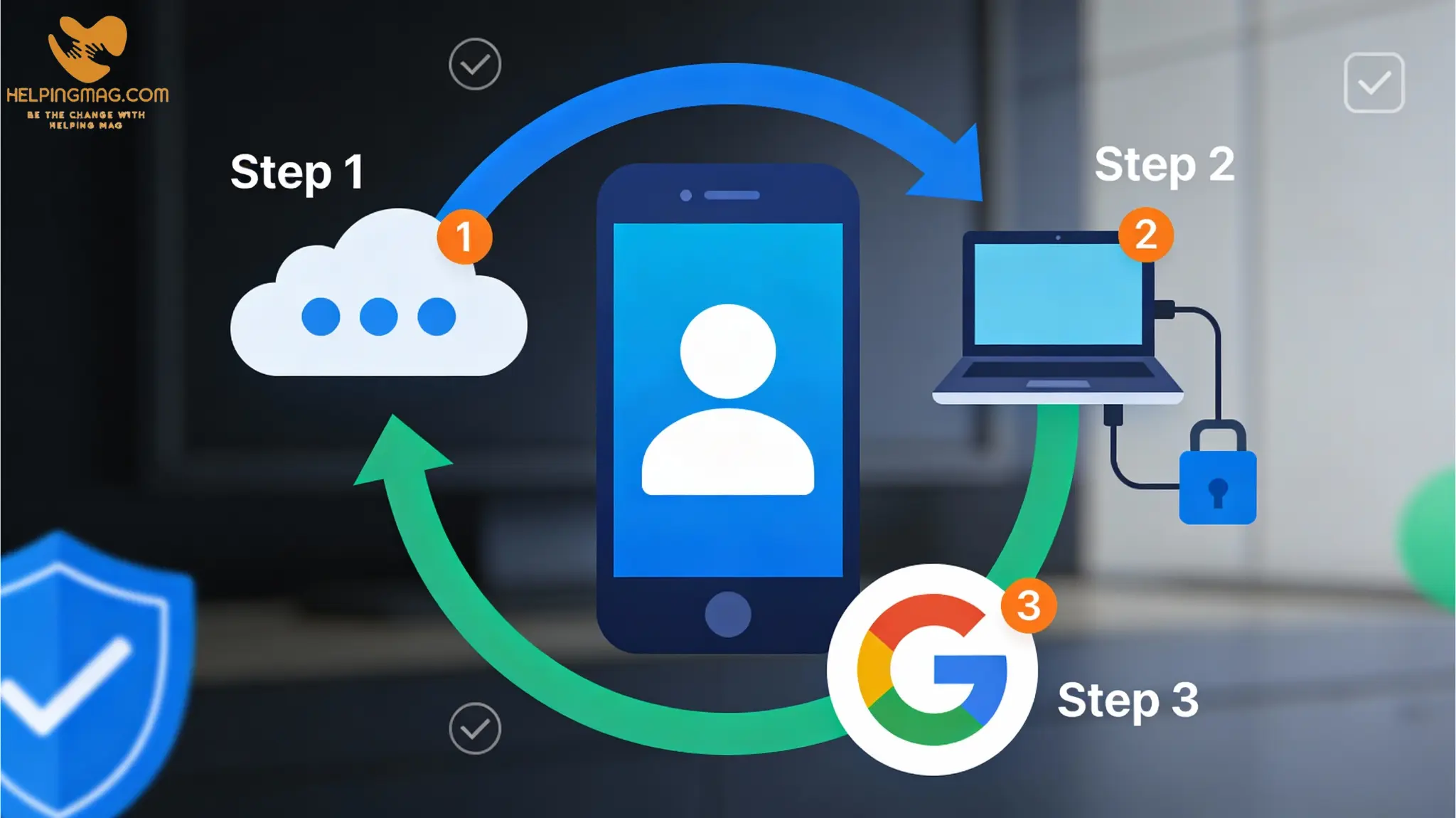
The loss of contacts in the iphone can end your contact with friends, family, clients and your workplace coworkers within seconds, therefore it is imperative to have the right backup plans. With the right tools, you will be in a position to protect your address book against acupuncture injecting loss, damage, theft, or malfunctions of the equipment or with the bugs happening in the program and fix it in a few minutes instead of going ahead to restart it all. It is a good descriptive approach on how one can most satisfactorily aid the iPhone contacts and an outstanding illustration on how the intelligent mechanism can be integrated to the contemporary digital life.
Reasons why iPhone Contact Backups are important
Contacts are no longer limited to the phone numbers and today they are crowded with emails, posts address, job description, company details, birthdays and personal notes which enable one to sustain a personal and professional connection. Suffering the loss of your iPhone without any backup can more or less imply that it could not be fairly done to reconstruct that network by hand, especially when asked to do so with hundreds of entries in that network that might have taken years to create. Loss of contacts can directly affect income, collaboration, and opportunities in the case of freelancers and the ones that are remote and business owners.
As technology has changed communication in general, so too your backup strategy ought to be corresponding in that smartphones changed our lives. Treating your address book as a valuable artefact of digital property as opposed to a list of digits, which just happen to be talkable, it is clear that only the structured backup method could save you in a connected world.
How to Prepare your iPhone to be backed up
Before you start copying contact information, it is best to do some kind of preparations to ensure that nothing can go amiss when verifying the process and the contact information that you have saved is of the right type. To begin with ensure that your iPhone is appropriately upgraded to the most recent iOS update by going to the settings followed by going to the General tab and then the Software update as the new releases have few security and reliability patches on the utilization of backup facilities. Thereon ensure that you are signed in with the correct Apple ID under the Settings menu as iCloud Contacts and iCloud Backup are both sub-accounts tied to this one.
You must also make sure that you are well connected. When it comes to cloud-based backup, a powerful Wi-Fi network will be necessary to prevent disconnection and access to a power source to ensure that the phone is not lost. Where it is possible, a good USB or USB-c cable must be used and where possible, without adapters. Inexpensive adapters are periodically lost. Finally, fill up your iCloud storage or the disk in your computer to at least be sure that the process of backup does not encounter any errors due to the absence of a considerable free space.
Method 1: iCloud to have contacts automatically synced
iCloud is the simplest and most convenient way of ensuring the safety of contacts to most individuals who use iPhones. Once enabled, iCloud Contacts will just but automatically synchronize your address book to all discussed devices that sign the Apple ID i.e. Apple-signed iPhone, iPad and Mac. Access to the addition, edits, and deletions of any contacts in one device are replicated in any place so that instances of conflicting information are minimal.
Enabling iCloud Contacts
This is done by enabling sending contacts with iCloud:
- Open the Settings app on your iPhone.
- Tap your Apple ID name at the top of the screen.
- Select iCloud and scroll to find Contacts.
- Toggle Contacts to the ON position so it turns green.
- If prompted, choose Merge so that existing local contacts are uploaded to iCloud.
So that this could be successful, you started your computer, opened your browser and went to iCloud.com, where you used your Apple ID to log in, after which you tapped Contacts. You want your phone to match the contents of your iPhone and this is a sure sign that you have your address book secure in the clouds.
The complete-device backups are also being offered by iCloud. To power on backing up iCloud: You have to switch on the iCloud Backup in the settings menu under your name, iCloud and iCloud Backup, so that you can generate periodic snapshots to be made more frequently over Wi-Fi in case your gadget is switched on. They consider these backups, which accommodates contacts, and has applications, settings, and any other data recovery that will pay you with a more versatile escape in case something goes wrong.
Advantages and disadvantages of iCloud Backups
- Pros: It is automatically made, wireless, built in with the Apple devices and can be restored on a new iPhone during the set up.
- Cons:5 GBs of free storage is combined with all the backups, photos and files and once again it might be necessary to upgrade depending on the number of applications and media possessed by the users.
iCloud Contacts will offer a very strong first-layer of protection that does not require a human factor as per the requirements of ordinary users who need a set-and-forget solution.
Method 2: Using Finder or iTunes to make Encrypted Backups
Nevertheless, the ease of using iCloud is due to the fact that most people maintain a local, encrypted copy of their contacts and nearly all other data on the machine via either the Finder on MacOS that can run Catalina, or iTunes on Windows (and with other older versions of macOS). It is one of the techniques that are especially useful when you just so happen to be having a slow internet connection or you feel like having full authority over your backups.
Backup via Finder on Mac
- Use a cable to connect your iPhone with your Mac.
- Unlock your iPhone and tap Trust This Computer if asked.
- Open Finder and select your iPhone from the sidebar under Locations.
- In the General tab, under Backups, select Back up all of the data on your iPhone to this Mac.
- Check the box for Encrypt local backup, create a strong password, and store it safely.
- Click Back Up Now and wait for the progress bar to finish.
Backup via iTunes on Windows
- Install and open the latest version of iTunes.
- Connect your iPhone and tap Trust on the phone when prompted.
- Click the device icon in iTunes to open the summary page.
- Under Backups, select This Computer and tick Encrypt local backup.
- Set a backup password and click Back Up Now.
These encrypted backups provide protection against sensitive information like contact notes, account data and also offer you a full restore point in the instance of large scale issues. To those working professionals who use productivity and computer tools on a daily basis, this form of security is compatible with the mentality of becoming more productive with blogging tips where being organised and efficient is the focal point.
Method 3: Google and Other Accounts syncing Contacts
Both iOS and Android have a big pool of users or they simply wish that their contacts will be available under a Google account. The process of syncing iPhone contacts with Google provides an individual with a multi-purpose system of seeing and recovering them on any device. It also creates an alternate reserve location not related with the cloud of Apple.
How to Sync Contacts with Google
- On your iPhone, open Settings.
- Go to Mail (or Contacts, depending on iOS version), then tap Accounts.
- Tap Add Account and choose Google.
- Sign in with your Google credentials.
- Ensure the Contacts toggle is turned on before saving.
When it is configured, the iPhone will be configured to synchronize contacts with your Google account. The contacts may be handled, edited, deleted, and imported into CSV or vCard file formats at contacts.google.com using any conventional web browser. This comes in handy immensely when you switch to Android or when you have to transfer a purged address book to a CRM or a marketing tool.
This kind of cross-platform backup is in the spirit of a more general thinking of using the correct AI tools to support remote work when combined with other tools that allow flexible, efficient, and location-independent productivity.
Exporting vCard Contact Individual Contacts
In case you just need to save a few of your essential contacts as opposed to the entire address book, it can be a good idea to export vCards on a case-by-case basis:
- In Open Contacts, select the individual and then choose the Share features where it is provided to mail or save the entry as a vCard file (.vcf).
- Keep valuable vCards in a cloud storage or on your PC as a secondary personal archive especially those high-value business or emergency contacts.
Method 4: With 3rd- Party Applications and Desktop Utilities
In addition to the solutions by Apple and Google, there are several third-party contacts backup solutions specifically used to create flexible exports of iPhones. Applications cited as an example: One can open up My Contacts Backup and run some mobile applications which will create a single vcf file containing all of your contacts, which can then be emailed to yourself or uploaded to some cloud based system. Use the Syncios and other devices like those to your desktop providing an opportunity to save your iPhone contacts in CSV, Excel or vCard format with a preview of all the contacts.
These tools are specifically useful in the situations when you need to:
- Removal of duplicates in a spreadsheet.
- Make contact lists to be imported to email marketing or CRM.
- Have several variations of your address book in reference to various projects or business ventures.
However, it is always necessary to check app reviews, the reputation of the application developer, and the privacy policies and then grant the applications the right to access your contacts. This conservative attitude is reflected by the mentality of using multi‑criteria online assessment tools for recruiters, when assessment results are more lucrative, relatively safer when tools are scrutinized.
Developing a Hybrid Backup Plan
One system may fail or be corrupted at any given time or be inaccessible at the very time when it is badly needed thus it is too risky to rely on a single backup medium. This can be made more effective by adopting hybrid approach and adopting a number of approaches at the same time such that you would never have a solitary copy of your contacts.
A workable hybrid course of action may appear as follows:
- Daily use: to ensure that iCloud Contacts is turned on, make sure that all of your Apple devices sync all of your new contacts.
- Monthly layer: Once a month or once you know your iPhone is about to undergo an enormous update/reset/or other changes, make an encrypted copy of your phone via Finder or iTunes.
- Quarterly layer: Put your contacts on Google and save a duplicate in one of the formats CSV or vCard and then save in place in the cloud or local storage in a place that is not modified.
This will be a three-step system that will make sure that the possibility of losing all the data is minimal. It is the same reason as unlocking your financial future because diversification and having a future will help to make things stable in the long run.
Cleaning Your Backups and Making them useable
The backup will have the same level of importance as the number of backup will. By the course of time, the contacts list will be full of the duplicates and outdated numbers as well as people who you do not need anymore in your phone. You save a disorganized list and you save a disorganized list and this can be frustrating in times when you needed one.
To maintain your backups clean and helpful:
- Regularly update addressbooks and get rid of the contacts you do not need like old temporary numbers.
- Unite similar records with the help of existing iOS, Google Contacts, or third-party applications.
- Pressure the important contacts with new job titles, emails and numbers whenever you get such information so that the backups will always be true to the real world.
The other action that you can use to test your backup is by restoring it after every one month or through a small test account as this way, you will be sure that everything has worked properly before you ever have to deal with a real crisis.
Frequently asked questions of iPhone contact backup
Q1. What are the frequency of iPhone contacts backup?
At least maintain iCloud Contacts active at any rate, and make a local encrypted copy either on your computer at least once per month or other times when there can be significant changes like updates or even changing the phone.
Q2. Am I able to charge contacts without using the internet?
Yes. iTunes and Finder backups are entirely offline in case you have an iPhone and a connection with the computer via a cable.
Q3. Are 3rd party contact backup applications safe?
Most of the apps provided by reputable people are secure, although you are in any case to verify with whom the application is made, to read and to look at reviews, and to be sure that the privacy policy is clear about the way your data is used and provided.
Q4. Once I delete a contact on my iPhone will it be deleted in all the backups?
It will be no longer visible in active synced contacts such as iCloud and Google in the future, yet older copies of it preserved before the deletion still have that contact until it is superseded by new copies.
Q5. Which is the most optimal single solution when I do not want to administer numerous tools?
To the majority of users, iCloud Contacts are enabled and sometimes iCloud Backup is running on provides the easiest, most convenient, and the least maintenanced (bare minimum protective) service.