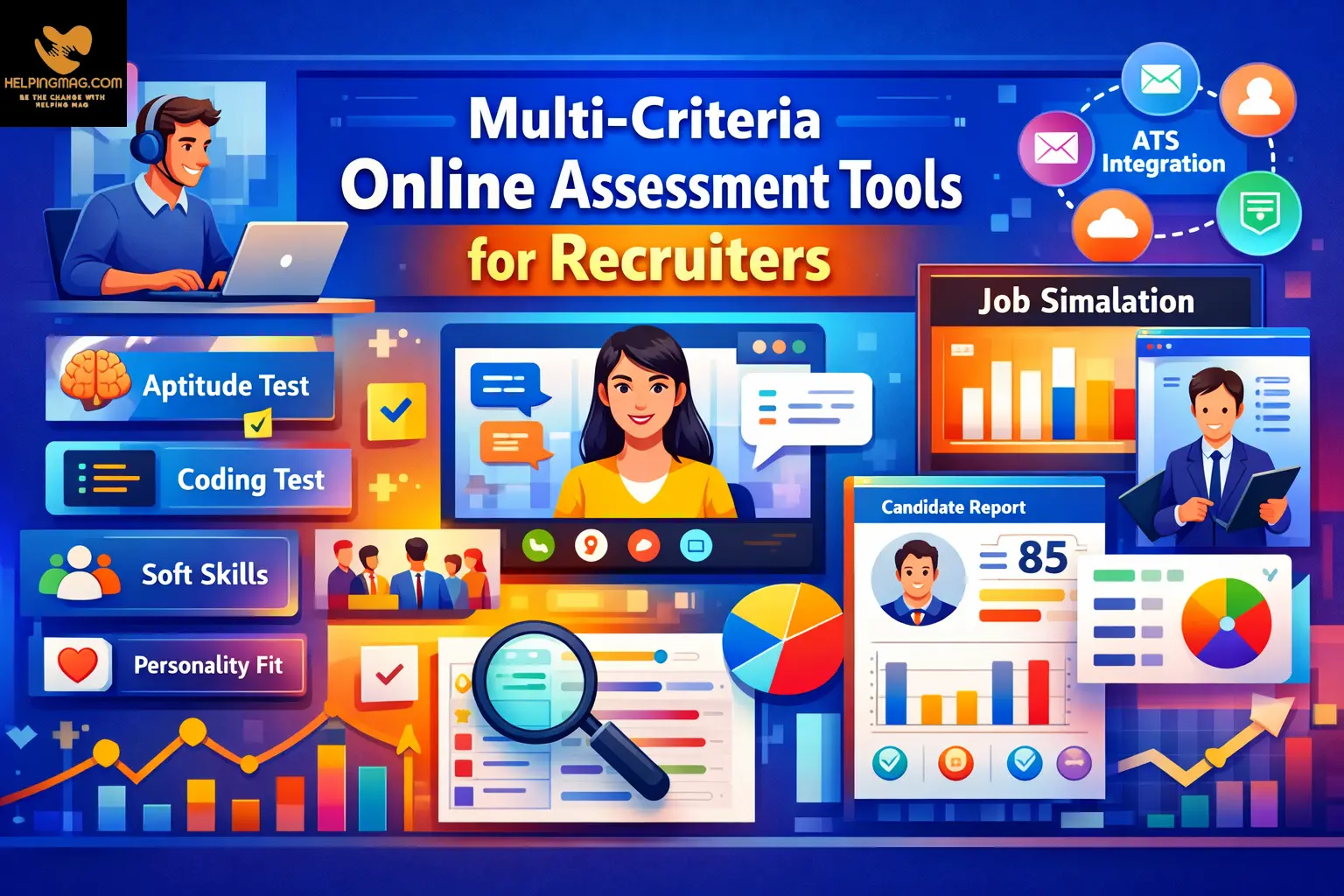
Online assessment tools let recruiters evaluate candidates faster and more objectively. They combine aptitude, technical and behavioral tests within one digitized platform.
Introduction: Why Online Assessment Tools Matter
The present recruiters must handle large amounts of applications and simultaneously hire quality employees. Screening takes time that is not unified.
The assessment tools simplify the process of hiring because they include objective data analysis reviews. This gets rid of discrimination and improves the precision of recruitment.
What Are Online Assessment Tools?
This is because these online platforms allow recruiters to online test a candidate in very large number of areas which include cognitive capacity, technical capacity, soft skills, and fit.
Examples of these are aptitude tests, psychometric tests, coding, situational judgment tests and realistic job simulators, each of them on the same interface.
With the right online assessment tools, recruiters can:
- Filter vast applicant piles within shorter intervals
- Visit the chance of creating regular scorecards to make comparisons
- Hiring should not be based on intuition but rather measurable data
Key Skills Online Assessment Tools Can Measure
The tools prepared in a proper way will provide the 360 degree view of each candidate by covering more than one skill areas in a methodical way.
- Thought abilities and aptitude
These are logical reasoning, numerical ability, verbal reasoning and analytical thinking which are used to single out candidates who have high potential problem solvers. - Technical and domain skills
Hard skills are tested with the help of coding tests, IT problem-solving and role specific MCQs and domain scenarios (e.g. finance, sales, construction, operations)
Well-structured role profiles and industry understanding can support this, similar to how a guide on exploring career paths in construction helps clarify skill expectations across job types. - Soft skills and behavioural capabilities
Communication, teamwork, leadership, and adaptability are the aspects that are crucial towards long-term success and measured by the situational judgment tests and the question formatted based on scenarios. - Personality and culture fit
The personality tests and work-style tests demonstrate how an individual would fit well in the organization in terms of values and working environment. - Job-specific simulations
Positive simulations Can be realistic simulations, e.g. sales pitch or customer support simulations: You can get a better prediction of on-the-job performance using realistic simulations than with traditional Q&A tests.
Must-Have Features in Modern Online Assessment Tools
Not all online assessment tools are equal, so recruiters should evaluate platform-level features along with test content.
- Customized basic test library
An excellent platform would have built-in aptitude, coding, language, and psychometric tests as well as an opportunity to build specific assessment to fit a particular position. - Remote proctoring and anti-cheating measures
In remote hiring, webcam proctoring, browser lockdown, randomised questions, and activity monitoring are useful to facilitate equity and test integrity.
These capabilities become even more powerful when combined with smart AI tools for remote work, which keep distributed recruitment teams productive and connected. - Actionable analytics and reporting
Detailed scorecards, competency-based break down, benchmarks, and recommendations enable the recruiters to shortlist candidates within a short time with a lot of confidence.
Just as practical blogging tips for businesses can optimize content strategy for better traffic and conversions, strong analytics in online assessment tools optimize the hiring funnel for better talent outcomes. - ATS and HR integration
It can be well integrated with the Applicant Tracking Systems (ATS), human resource management systems or recruitment CRM to facilitate the smooth process between application and offer. - Scalability and automation
Hundreds or thousands of applicants Campaigns: Automated invites, reminders, scoring and shortlisting are used to settle campus drives and mass recruitment requirements.
Best Practices for Recruiters Using Online Assessment Tools
To get maximum value from online assessment tools, recruiters need to align assessments with real job requirements and candidate experience.
- Begin by having a well-defined competency framework of each job, establishing the set of must-have and good-to-have skills before picking tests and the level of difficulty.
- Assessment scores can be used to help frame structured interviews (not to fully eliminate human interaction) to ensure that qualitative data can be efficiently supplemented by quantitative data.
- Incorporate process and expectation messages to the applicants to be transparent, equitable, and have a great employer brand.
- For technical and automation-heavy positions, design assessments that reflect real work tasks—similar to the practical scenarios covered in 6 Advanced Python Automation Testing Techniques, which highlight how deeper technical evaluation can separate average from high-performing candidates.
When thoughtfully implemented, online assessment tools help recruiters consistently identify high-potential candidates, reduce mis-hire risk, and build a stronger, future-ready workforce—all while saving time and improving the overall hiring experience for both HR teams and applicants.