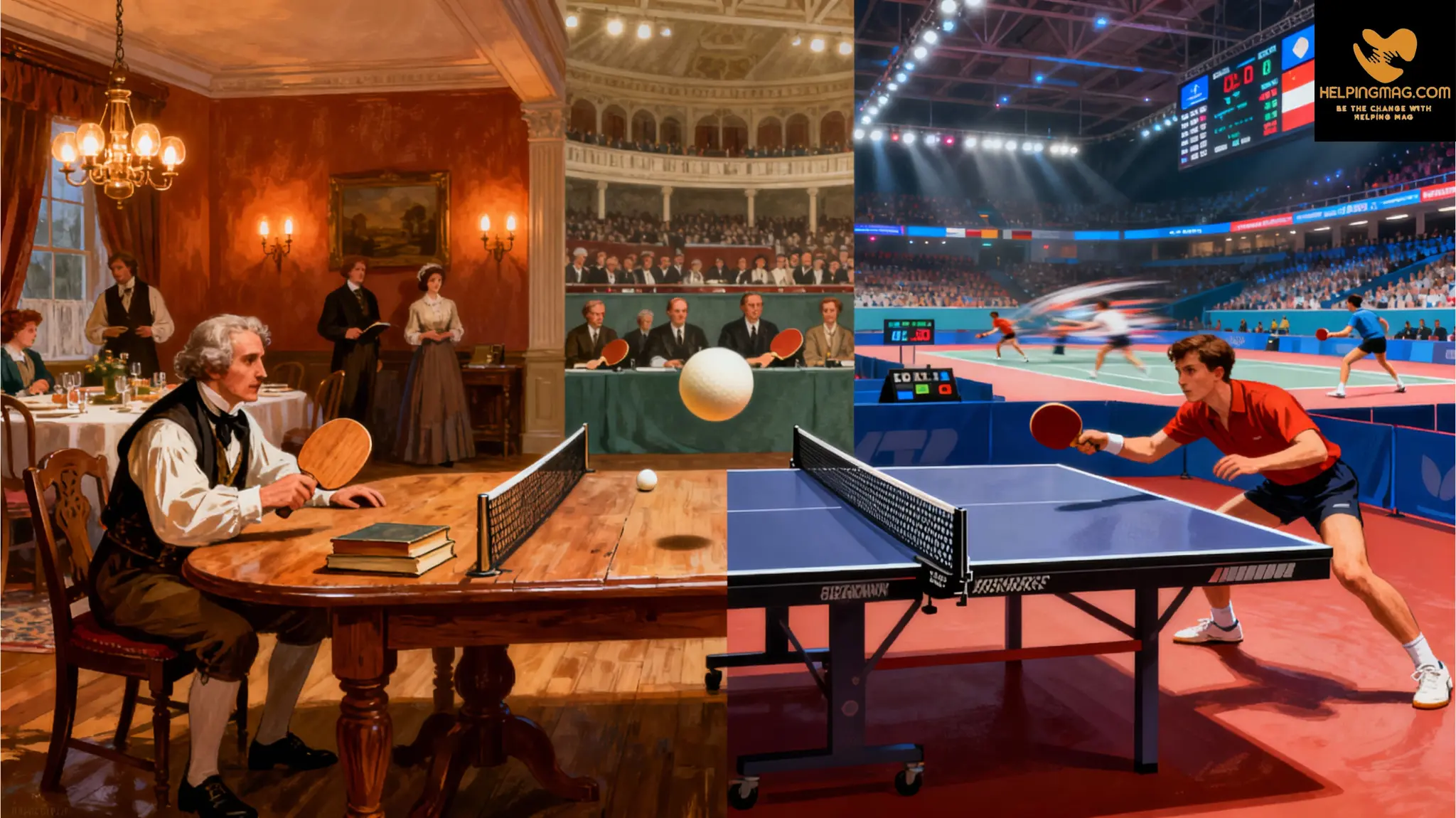
Table tennis started as a rather strange Victorian parlour game in England and then evolved into one of the most technical and fast sport forms in the world. The history behind its discoveries on the dinner tables under gas lamps and then in the Olympics arenas is a story of societal development, brilliant discoveries and even political issues around the world.
Drawing a line down the table
Towards the end of the 19th century, high social Victorians sought to find some means of indoor popular outdoor games such as lawn tennis in the long and wet period of the year. They would use dining tables as improvisers, line books down the centre like a net, make use of books or the lids of cigar boxes as bats, and they would also use rubber or cork balls or even golf balls.
This makeshift table tennis went down to the earlier racket games like real tennis who had been performed over centuries in Europe. With the tennis craze over the lawn in the 1880s, the notion of a smaller copy on a table was intuitive as long as people had the space, time, and money to indulge in such trifles. The high-end roots of the sport remind me of the way that in most cases technologies have become pricey or luxurious, but later on become a need, and the same trend can be followed in digital habits and productivity when going through your guides on making remote work more efficient.
From “Gossima” to “Ping‑Pong”
Producers could not take long to see the hype and began to market boxed sets using standard equipment. One of the earliest known setups of a table-tennis style game, with an accompanying table-lawn-tennis set consisting of strung rackets, a rubber ball and side nets, was patented in 1890 by Englishman David Foster.
As they tried to win the market, brands came up with such names as Gossima, Whiff -Waff and Ping -Pong. The sound of the ball in bat which was a clicky one gave the name Ping-pong which very soon became the most preferred name referring to the game. J. Jaques & Son, a British manufacturer, registered a trademark name Ping-Pong, and the rights in the United States were acquired by Parker Brothers, which is why official institutions tend to use the neutral name of table tennis as the one that does not refer to a particular goods.
A bouncing breakthrough: the celluloid ball
The initial equipment restricted the speed at which and spin heavy the game would get. The balls made of rubber were heavy, and unpredictable, and improvised bats of books or lids of wood did not give much control.
In the United States around an approximate year of 1901, small celluloid balls were found by an Englishman known as James Gibb, who took them to England. Such balls were more consistent and bouncy and immediately rallies became quicker and more thrilling. Shortly type EC Gould created bats with rubber pimples on them that caught the ball and spin became part of the game. This technological perfection drove the sport out of parlour trick and into serious competition as the right tools and workflow can transform monetarily viable casual blogging into a viable business business, a theme that you also discuss in your blogging and productivity content.
Early associations and the name “table tennis”
The game spread very fast thus forcing players to codify rules. One in 1902, a Ping-pong Association was established in England which died in a couple of years as there was a decline in the interest as well as the complications of legal matters involving brand names.
Formal bodies failed but the game was kept alive in clubs and in the homes of the wealthy in Europe, particularly in England and Hungary. By the early 1920s, a new breed demanded a form of government using a neutral name of table tennis. In 1921, the Table Tennis Association was established by enthusiasts but would be renamed to English Table Tennis Association in the year 1922 to distinguish between the sport and the commercial name of Ping-Pong.
Birth of the International Table Tennis Federation
This turning point was reached in the year 1926 and the leaders realised that the sport required a worldwide governing body. In December the same year, the leaders of nine of the original members including Austria, Czechoslovakia, Denmark, England, Germany, Hungary, British India, Sweden and Wales convened in London to form the International Table Tennis Federation (ITTF). Hungarian-born Ivor Montagu was an important scholar of original rules and leadership.
The first World Table tennis championship was also held in London in 1926 and this made table tennis an organised world sport in a very strong way. During the decade, Hungary triumphed over the championships as such players as Viktor Barna and Maria Mednyanszky took several titles and set new standards of playing with tactic and technical perfection. This dominance at the beginning is like those who come out early and set standards that others can work towards, like those early adopters who determine the trends in online business and digital‑tool usage that you often analyse.
The power and development of tactics of Europe
Between 1926 and the Second World War, international titles were under the control of European countries with greater control of Hungary and Czechoslovakia and ultimately England. Their players raised their strategy, learned topspin, backspin, and acute angles which made moves between the ball participants into a realistic battle of fortifications, positioning the rounds, and patience.
Administrators progressively perfected the laws to enable matches to be fair and entertaining to watch. The net height, rules on serving and ball specifications were also made uniform in different competitions ensuring that players in various nations were subjected to the same standards. Only then did the sport have to walk the fine line between tradition and innovation, just as digital creators today walk the line between tradition and innovation in terms of developing authority content like in-depth guides on finance, careers and technology.
Asia rises and China takes over
Since the Second World War, the power balance between Asia and Europe has changed. New equipment and playing styles were introduced by Japan and afterwards by China which revolutionized elite table tennis.
Sponge-rubber paddles became well known in the 1950s, when Japanese players adopted the use of sponge beneath the top layer of the paddle to give much greater speed and spin. Soon such innovations were introduced and developed by Chinese players, and associated with strongly structured training systems. They preferred close-to-the-table attacks that were aggressive, precise footwork, and turning-points into an explosion of a one-look-and-you-miss relationship. Since the middle of 1950s, China has won both individual and team competitions and this has made table tennis the national glory and global honor.
Ping-Pong diplomacy: when politics came to sport
The early 70s of the Cold war saw the sport captured by politics at the global stage through table tennis. In 1971, the Japanese organisers, in conjunction with the Chinese officials, made an arrangement to invite American players to visit China when the formal US-China relations were in freeze.
The so-called Ping-Pong diplomacy as this surprise goodwill visit was later to lead to the high-level political discussions, and in a bid to cool the heated tensions between the two countries. It is emphasized by the ITTF because it is one of the most memorable moments in the history of the sport, and it proves the fact that even a niche game can have an impact on the world. Later on in life, teams and friendship matches still featured this culture of table tennis as a means of conversation, and this is replicated in how collaboration tools and platforms can satisfy worlds apart in the remote working environment today, one of the things that you also mention in your coverage of AI tools that enhance collaboration.
From basements to the Olympic Games
Throughout most of the 20th century, the sport of table tennis had existed in a dual reality: both as a professional or professional-amateur sport and as a hobby in the basement, garage, or community centre across the globe. It was very popular because of its low cost of equipment, minimal space usage and makeshift tournaments thrived in schools, youth clubs and offices.
The sport was given a new boost in the years 1988 when it was in the Olympic programme in Seoul Games where it became part of the Olympian programme. Olympic status increased media coverage, sponsorship and youth development packages as well as compelling the organisers to make the event more television friendly. New ideologies included contributions like ball size increase and 21-point to 11-point games in order to reduce rallies and increase the dynamism and ease in following scoring by the casual viewers.
Technology, materials, and modern speed
The present-day table tennis equipment is an indication of great improvements in materials science. Blades are now being produced to integrate synthetic fibre (such as carbon) with the various types of wood to control the stiffness, vibration and weight as well as rubbers are being developed to play a specific purpose – some give maximum spin and others focus on speed or control.
The ball was developed into a 38 mm celluloid ball and then to a 40 mm plastic (poly) ball which slowed the game down a bit, and made it better to see on a television screen and on the arena floor. These improvements compelled players and coaches to differ on grips, timings and strategies. The use of video and data-driven approaches to elite training is growing to reflect the trend among the practitioners of other professions, where sophisticated devices are incorporated into workflows, similar to the model that you describe in your articles about leveraging AI and digital tools for better productivity.
Grassroots growth and everyday play
Nevertheless, with a high-tech competitive advantage in the top, table tennis is still intensely grassroots. New players are still getting initiated into the game through local clubs, schools and recreation centres with basic equipment and informal instructions. Tables in parks and areas make outdoor sport more normalized and social, as it is a sport that anyone can have a go at.
Table tennis is used in the development projects of different regions to support social inclusion, youth engagement and health. The game requires quick reactions and acuity as well as subjecting joints to comparatively limited stress in comparison to numerous contact games, which renders it friendly across all ages. This makes table tennis an accessible real-world app: simple to begin playing, but strong in terms of how it connects people in a manner.
A living history on every serve
All the present-day serves in table tennis bear the relic of the old, the improvised Victorian dining rooms, the first sound of the celluloid ball, the smoke-filled European halls in the 1930s, the diplomatic handshake between East and West, the Olympic spotlights. The origins of the sport as a form of diversion after dinner can still be traced in the characteristics of its friendly, fast-paced rallies, although on the highest levels of the sport it has evolved to a very technical, physically demanding, and globally followed sport.
In the case of the storytellers, entrepreneurs, and sports fans, the history of the development of table tennis explains how the smallest innovations can become an international movement, when technology, culture, and imagination are involved. Similarly to the way your long-form business, money and digital tools manuals manage to incorporate most themes into one single product, table tennis incorporates different times and backgrounds, and it is a great reminder that even the most basic games can create great big histories.