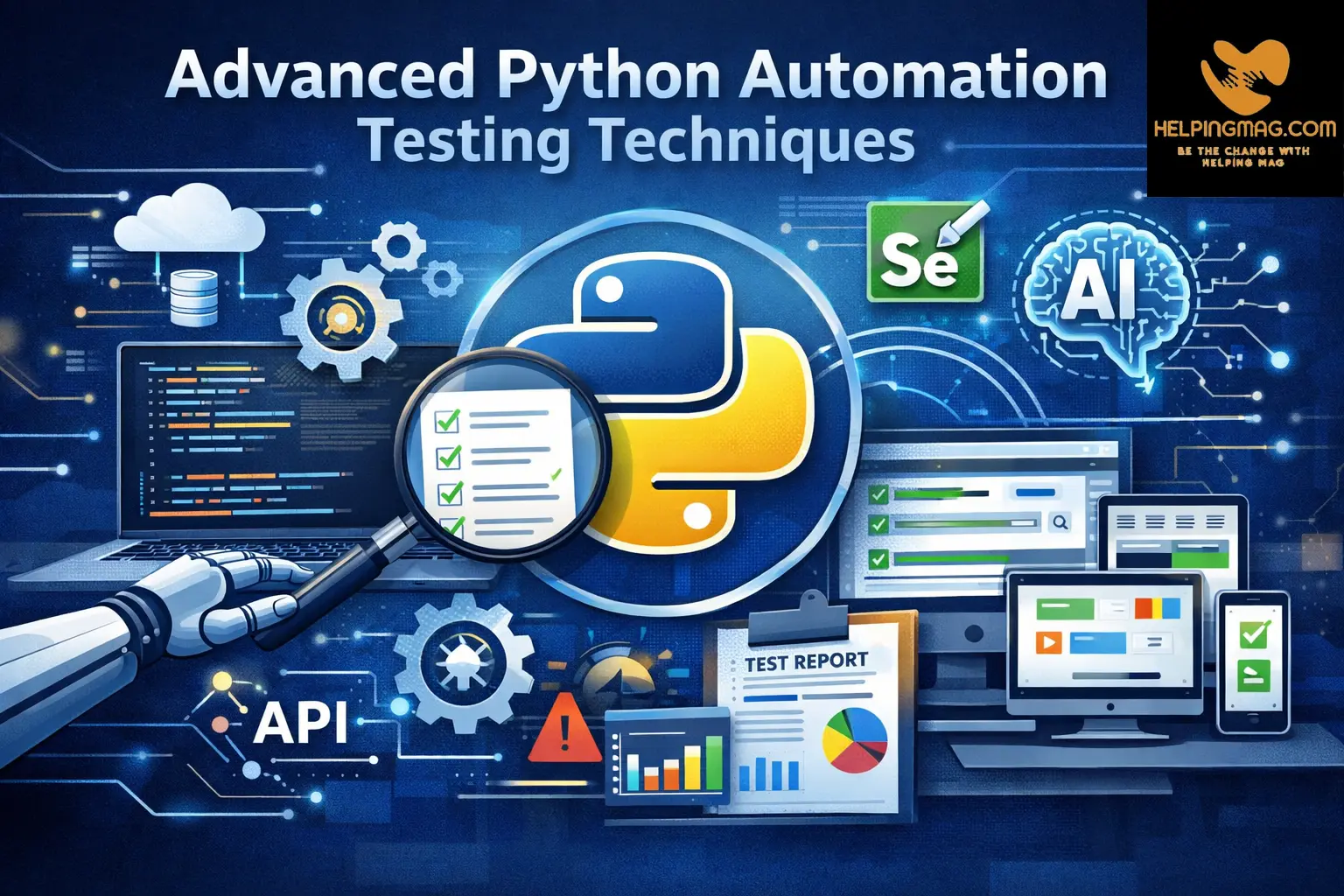
The automation testing based on Python has gone a long way beyond scripting and rudimentary statements. The current-day QA engineers and programmers require scalable, maintainable, and smart automation plans to keep up with the accelerated software releases.
This article presents six Advanced Python Automation Testing Techniques that can be used to enhance the accuracy of tests, speed, and maintainability of tests over time, but does not get overly complex with your test framework.
1. Data-Driven Testing for Better Coverage
A data-driven test enables one test example to test various scenarios with varying input values. Answers that are hard-coded as test data are brought in by CSV files, Excel sheets, Jerome, or databases.
Python tests are flexible and scalable as testers easily parameterize test cases through Python frameworks such as pytest.
Why it matters:
- Improves test coverage without duplicating code
- Makes test cases easier to update
- Good in verifying forms and API
Such an organized method fits the patterns of modern development usually presented in forums such as HelpingMag, where tech trends put a high value on automation and efficiency.
2. Page Object Model (POM) for Maintainable UI Tests
One of the most significant design patterns that is critical in automation testing is the Page Object Model (POM). It isolates test logic together with UI locators hence less maintenance is required when the application UI is modified.
Every page of application is implemented as a class, which contains all items and actions concerning the page.
Key advantages:
- Cleaner and reusable code
- Faster updates when UI changes
- Improved cooperation in big QA teams
This modular thinking resembles the functioning of content management systems, which has been discussed in WordPress for bloggers.
3. Parallel Test Execution to Reduce Test Time
As the number of applications increases, so does test suites and in turn, their slowness. Parallel testing assists in conducting numerous tests at the same time with the help of such tools as pytest-xdist or Selenium Grid.
This method is particularly useful in CD pipelines with quick feedback being a mandatory requirement.
Benefits include:
- Reduced execution time
- Faster bug detection
- Better cross-browsing is discovered
Parallel testing has become essential in modern remote and distributed development environments, similar to workflows discussed in AI tools for remote work.
4. API Automation Testing with Python
The use of UI tests may be dangerous. Engineering API automation testing has been used to ensure the validity of the backend functionality, before the UI is engaged. Testing the APIs is fast and consistent with use of Python libraries like requests.
API testing ensures:
- Correct data exchange
- Quick test execution as compared to UI tests
- Early bug detection
It is especially noticeable in case of fintech and digital platforms, where reliability of the system is a major concern, as is the matter of financial stability in how to improve your credit score.
5. Advanced Logging and Test Reporting
Without meaningful reports, the process of automation cannot be complete. Advanced logging assists testers to detect failures, environment problems as well as wobbly tests rapidly.
The most popular reporting tools include:
- Allure Reports
- HTML Test Reports
- The logging facility built-in of Python
In-depth reportages help in improved decision-making and responsibility – which is also promoted in the professional development courses as well, like how to ask for a pay rise.
6. AI-Assisted and Self-Healing Automation
The use of AI has changed automation testing. Self-healing scripts are self-healing, meaning they modify themselves to the changes in the UI, improving low maintenance and unstable breakage. Python is compatible with AI and smart locators.
This next generation strategy enhances:
- Test stability
- Maintenance efficiency
- Long-term scalability
AI-assisted testing reflects how smart technologies are changing work and learning methods, as explained in how to use ChatGPT at work and study.
Conclusion
Advanced automation testing methods using python are no longer optional, they are considered vital to creating reliable and scalable software. Through the application of data-driven testing, POM, parallel testing, API testing, intelligent reporting, and AI-assisted testing, QA departments can increase software quality by a considerable degree and decrease the number of manual efforts.
With the rising pace of business expansion and the implementation of automation-based first-mover approaches, learning these methods will provide testers and developers with a powerful competitive advantage.